Europe has undermined its competitive standing in global exports – Russia’s Economic Development Minister (FULL INTERVIEW)
RT · 1 天前
Maksim Reshetnikov says APEC will test whether trade, energy and dialogue can survive rising rivalry and protectionism
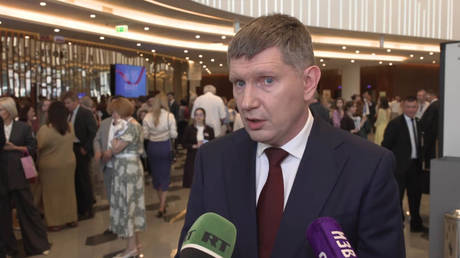
As Asia-Pacific leaders prepare to gather for this year’s APEC summit, Russia’s Minister of Economic Development Maksim Reshetnikov says the meeting will unfold against a backdrop of deep disagreement over the future of global trade, sanctions, energy, and technological competition. In an interview with RT's Murad Gazdiev, he contrasts APEC’s traditionally constructive agenda with the more conflict-driven nature of the G20, outlines Moscow’s position on American tariffs and protectionism, and explains why Russia sees affordable energy, open markets, and long-term workforce development 2 including in nuclear technologies – as central to a more stable global economy.
Murad Gazdiev: Mr Minister, thank you for making time for us.
These are challenging times – not just for Russia, but for the entire world, affecting both the prosperous and wealthy, as well as the poor and disadvantaged.
My first question: the APEC summit will take place in November, and, as always, its work will focus on deepening integration, promoting trade, and combating protectionism.
What are your expectations for this year’s meeting?
Maksim Reshetnikov: I believe the dialogue will be challenging because, on one hand, China – serving as this year’s leader – is promoting an agenda centered on upholding the principles of free trade, the most-favoured-nation regime, and protection against discrimination. They are proposing to broaden this scope to include issues such as e-commerce and the unrestricted use and dissemination of artificial intelligence.
While this agenda is quite ambitious and timely, it’s premised on the assumption that the world will, in some form, maintain a degree of globalisation and interconnectedness, with trade and other channels remaining open, and it clearly clashes with a different vision, primarily that of the US administration.
I expect the entire discussion to revolve around this profound and substantive disagreement. I am confident that efforts will be made to find language that can chart a careful path forward. At events of this calibre, it is rare for the choice to be framed as a binary “either-or” (left or right). Instead, the focus is almost always on reaching an agreement and identifying steps toward finding common ground.
Murad Gazdiev: As a minister, you regularly represent Russia – not only within the APEC framework but also at the G20. There was a meeting of G20 trade ministers recently.
In your view, what is the fundamental difference between APEC and what can be achieved within the G20?
Maksim Reshetnikov: These formats were created under different circumstances. APEC was originally conceived to deepen regional integration – with the ultimate idea of a free-trade zone. Of course, everyone understands that in the current climate, this is difficult to implement – or, at the very least, it is a goal that would require a great deal of time. That is why the approach involves taking incremental steps, such as exchanging experience. In general, the APEC agenda is always positive; the focus is consistently on finding common ground and building upon it, while setting aside points of disagreement. The G20, by contrast, emerged during the Asian financial crisis.
It is geared toward addressing conflict situations – dealing with issues in the here and now – where there is a need to mobilise and overcome specific challenges. The discussions there tend to be much sharper. That, perhaps, is the fundamental difference between the two formats.
Murad Gazdiev: And given that you represent a country currently under sanctions imposed by a significant number of G20 members, how do your objectives align with the broader goals of the Russian delegation? Did you single out any specific topics that could be discussed at the G20, as opposed to those that should be brought to APEC for resolution?
Maksim Reshetnikov: The objective in any negotiation is to defend national interests – long-term interests. Our long-term interest lies in remaining integrated into the global economy, opening up new markets, keeping our own markets open, and negotiating fair terms of competition.
We have an efficient, competitive economy. The only thing that could hinder us is unfair or unequal treatment.
Such unequal treatment in trade – which affects not only the Russian Federation but also our partner nations – is problematic; after all, these are our markets, and anything that impedes the development of our partner nations also limits the prospects for our own exports.
For instance, at the G20 summit, there were four key topics on the agenda.
The first concerned the “most-favoured-nation” (MFN) principle. Our American partners sought to test the waters – to see if it might be possible to discard or diminish the significance of this fundamental tenet of the World Trade Organisation and global trade as a whole.
However, this did not even make it into a draft resolution, as it was clear that such a proposal would neither be understood nor reciprocated.
While many acknowledged that certain issues have indeed arisen regarding the application of this regime, it was generally agreed that it must remain an inviolable foundation – a core principle and a fundamental value.
Furthermore, the discussion turned to the issue of protectionism. Specifically, as you are aware, the US administration has imposed sanctions on 60 countries, citing the alleged use of forced labour. As for APEC, sanctions – in the form of additional import duties ranging from 10% to 12.5% – have been imposed on 18 of its 21 member economies.
Naturally, many were puzzled by the ease with which the US administration employs such terms. The concept of “forced labour” is well-defined under international law, and its application falls within the purview of the International Labour Organisation. Typically, this involves the investigation and substantiation of specific cases. Never before have entirely unsubstantiated allegations been used as a basis for imposing tariffs on entire countries.
Consequently, this sparked a very heated debate, and the United States, unsurprisingly, failed to find any support among its partners on this issue.
However, there was one area where an agreement was reached: the so-called “weaponisation” of food trade – that is, the use of food trade as a tool for exerting pressure through sanctions.
For our part, it was crucial to ensure that the definition of “food” was broadened to include not just food products, but also items like fertilisers – essentially, anything that directly impacts agricultural productivity.
Furthermore, it is important to recognise that food trade encompasses more than just the simple buying and selling of wheat; it also involves freight, insurance, and financial settlements. Restricting the sale of mineral fertilisers or prohibiting the insurance of vessels, for instance, has a profound impact on the market. It leads to a significant rise in shipping costs and affects the economies of various nations – often countries that have no connection to the underlying conflict. This is particularly true for many African and Asian nations that are heavily dependent on such imports. And this is not just a matter of rising food prices; often, it is a question of the very survival of entire nations that are heavily dependent on imports – including those from the Russian Federation.
Murad Gazdiev: Yes, any stress placed on a single link in this supply chain inevitably leads to problems throughout the entire chain. But regarding...
The tariffs imposed by the US are not the only factor hindering the development of trade. There are also the strict prohibitions – import bans – that we are witnessing. For instance, the Chinese automotive industry has effectively been shut out of the US market. There is simply no entry into the US.
At the same time, exports from the US – specifically high-tech goods and chips for artificial intelligence – are also subject to severe restrictions.
China, much like Russia, has spoken out against this, stating quite openly that it opposes any form of new protectionism.
What is the current position of the Russian delegation? Is there anything that can be done to alter the course currently being pursued by the US and certain other nations?
Maksim Reshetnikov: We are calling for dialogue here because the use – or rather, the abuse – of various pretexts to impose import duties and engage in protectionism has become quite widespread. National security, for instance, is the justification used for things like bans on chip exports, the expansion of export controls, and so on.
In essence, these are all forms of unfair competition.
But there are also more – shall we say – refined or sophisticated methods. Take the climate agenda, for example: in the hands of certain countries and blocs, it is simply being turned into a pretext for imposing import duties.
For instance, we are currently in a dispute with the European Union regarding its Carbon Border Adjustment Mechanism. In reality, this functions as a form of taxation on imports from certain countries for the benefit of others.
Essentially, it’s just another set of tariffs.
Yes, effectively, they are tariffs.
And that is why, as we speak, a climate conference is taking place in Antalya under the framework of the Paris Agreement.
We are using that platform to emphasise the need to define the boundaries – to clarify how climate policy and trade should intersect, what conditions must be met, and so forth.
Because the climate issue is critically important. Climate instability and global warming are having a real impact on the economy. At the same time, attempts to impose uniform energy transition models – by labeling sources like coal or gas as inherently bad – are problematic. This is especially true given that energy consumption across the African continent is set to grow significantly. Pressuring our African partners to adopt expensive and unstable energy solutions – often based on technologies supplied by the very same European nations – amounts, in our view, to a form of protectionism.
Furthermore, with the rise of artificial intelligence, the cost of electricity has become a critical factor; it can effectively be used to stifle the promising technological and industrial development of nations, thereby hindering improvements in people’s well-being.
Our position, therefore, is to remain as pragmatic as possible. We must consider the impact on the lives of individual people – primarily, of course, our own citizens in Russia. Yet, we also recognise that the world is interconnected; it is vital for us to see growth in global prosperity and international trade, as the Russian economy itself is directly dependent on these factors.
Murad Gazdiev: Since you’ve brought up the European Union, many European states have faced a significant downturn in economic activity. There are countless reasons for this – one could discuss them at length – but it is partly due to policy decisions made by their respective governments.
In your view, to what extent have the current global upheavals impacted the economic performance of APEC member economies?
Maksim Reshetnikov: You mentioned our European counterparts. Their situation serves as a prime example of how a series of decisions – each seemingly logical, or at least explainable in some way – can, when taken together, actually drag down both the pace of economic growth and the overall level of economic development.
Everyone – those living in Europe and those who simply analyse the statistics – notes that problems are piling up, and doing so rapidly, with no clear way out.
On one hand, they aggressively pursued a “green agenda,” abandoning the development of nuclear energy and even shutting down existing nuclear power plants.
On the other, they burdened their own industries with carbon-adjustment mechanisms and various other levies, rendering them uncompetitive on the global stage.
They undermined their own competitive standing in global exports through excessive export controls.
They missed the boat on technological modernisation in the automotive sector, losing the competitive battle to China entirely.
Compounding all of this was the decision to move away from Russian energy sources in favour of American ones, which come at a significantly higher cost – the price of electricity in the US is half that of Europe, and energy costs in Europe have risen by 50% over the last five years.
Clearly, it is impossible to build a competitive economy under such conditions; and this has only exacerbated existing problems, and so on.
But let that be – these are their own issues and their own problems. European consumers will be tested for as long as they are willing to endure it.
We, however, must forge our own path and develop our own technologies.
Naturally, we continue to promote our energy resources. We view natural gas as a transitional fuel – one that helps address climate concerns while simultaneously ensuring access to electricity at reasonable prices.
At the same time, we are actively promoting nuclear technologies; we are currently the world’s largest exporter in this sector, which keeps us a step ahead of everyone else.
We also take a pragmatic approach to renewable energy sources, with a clear understanding of how to utilise them effectively.
For instance, solar and wind power integrate very well with hydroelectric plants – specifically those with large reservoirs capable of long-term storage, which essentially function as giant batteries. We have several such projects in the Far East.
These systems offer a strong capacity factor and high efficiency.
Consequently, in the southern part of the country, we are implementing energy storage systems and fine-tuning the regulatory framework to further boost the efficiency of our economy.
Our primary focus remains on addressing our own domestic priorities.
Murad Gazdiev: Of course, there are always external factors at play. In fact, we recently discussed one of these with one of your colleagues – a minister – during a closed-door session. I won’t go into the details of that private conversation.
We asked: what is the situation between the US and Iran? Just how bad is it? We received a comprehensive answer – though it came from someone in a military uniform.
From your perspective, we know that APEC is taking place against the backdrop of a conflict between the US and Iran – a conflict that undermines stability and has disrupted trade routes and the flow of energy resources to international markets, many of which were destined for Asia.
The question is: to what extent does all of this affect current dynamics, as well as future projections? And how does it impact investment within APEC – and, ultimately, the economic future of the APEC region as a whole?
Maksim Reshetnikov: We should probably discuss how all of this affects the global economy as a whole, given that APEC represents such a significant portion of it. Moreover, because markets are global, the impact spreads everywhere through various channels.
The first thing everyone encounters, of course, is rising energy prices.
A second point – closely related, though perhaps less immediately obvious – is the increase in the cost of fertilisers and metals. These were produced in this region, partly by leveraging low-cost electricity; the same applies to various industrial gases used in microelectronics.
Consequently, these effects rippled through value chains, primarily resulting in inflation – or, more simply, higher costs.
Indeed, the data shows that global inflation has accelerated significantly of late.
On top of this, there are issues with transportation routes – not just in the Strait of Hormuz, but also in the Red Sea and the Suez Canal.
This leads to higher shipping costs, which, once again, fuels inflation.
Furthermore, this intersects with the climate agenda; for instance, the International Maritime Organisation is currently exploring ways to phase out certain types of fuel in favour of alternatives – all of which ultimately just drive up fuel costs, transportation expenses, and so on.
It’s essentially a “layered cake” of questionable decisions. Ultimately, it is the consumer who will pay for all of this. In terms of the burden relative to income, the most significant price increases are not an issue for America or Europe, but rather for Africa and Asia – regions where people have relatively low incomes. In the end, it is the end consumer who bears the cost of all these geopolitical games.
And, as a rule, these are the very consumers who have the least amount of money.
That is why we position ourselves as a reliable supplier of resources, as well as a dependable provider of transport services.
We are seeing growing demand for the Northern Sea Route. It is fortunate that we have spent the last few years preparing for this – building icebreakers, investing in infrastructure, and ensuring we are ready to provide vessel escort services.
In this regard, our position is strengthening.
Furthermore, such projects help stabilise the situation and create development opportunities for APEC member countries.